Drylining

Dot-and-dab drylining

Dot-and-dab drylining for brick and block walls: plasterboard bonded with adhesive, taped or skimmed. What's included, process and typical UK costs.

In short: Dot-and-dab drylining bonds plasterboard directly to brick or block walls using dabs of gypsum-based adhesive, giving a flat wall ready for taping or skimming. It suits new builds, extensions and stripped-back renovations where the masonry is sound and dry. In the UK it typically costs £25 to £45 per square metre supplied, fixed and taped.

Get a free quote

Fixed price, no obligation. We aim to reply the same day.

By sending this form you agree to be contacted about your enquiry. See our privacy policy.

Dot-and-dab drylining

Dot-and-dab is the quickest way to line a masonry wall. Adhesive is applied to the wall in vertical rows of dabs, and the plasterboard is pressed into it and tapped back to a straight line using a long straightedge. Because the adhesive takes up the unevenness of the wall, the finished surface can be flat even when the blockwork behind it is not perfect. The board ends up roughly 15 to 25 mm off the original wall.

It is the standard internal finish on most new-build masonry houses, and it is widely used in extensions and renovations once the old plaster has been stripped back. It is not suitable for every wall. Damp walls, walls with loose or contaminated surfaces, and walls that are badly out of plumb are better dealt with by fixing the board to a frame instead, so the right method is checked before any adhesive goes on.

What is included

  • Checking the wall is sound, dry and suitable for bonding
  • Priming very porous or high-suction masonry where needed
  • Setting out and marking sockets, switches and openings before boarding
  • Continuous adhesive bands around board edges, openings and service boxes to limit air leakage
  • Fixing boards plumb and flat, with cut edges kept to corners and junctions
  • Angle beads on external corners and window reveals
  • Tape and joint or full skim finish, as agreed
  • Clearing offcuts and adhesive waste at the end of each day

Who it is for

  • New-build and extension blockwork walls
  • Renovations where old plaster has failed and been stripped
  • Rooms where you want to lose as little floor space as possible
  • Sound, dry masonry that is reasonably straight
  • Projects where wet plaster drying time would hold up the programme

How much does it cost?

As a guide, dot-and-dab usually costs £25 to £45 per square metre supplied, fixed and taped, with a skim finish adding around £8 to £15 per square metre. Stripping old plaster first, lots of reveals and high walls push the price up. See our full cost guide.
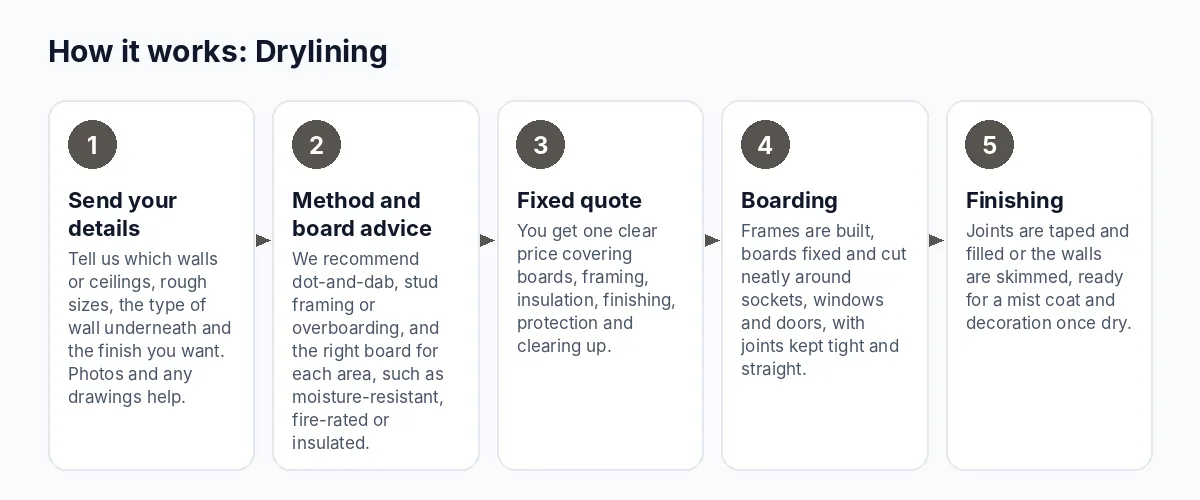
How it works

How dot-and-dab drylining works, step by step
  1. Survey the wall

    We check for damp, loose plaster, paint or contamination, and how far out of line the wall is, which decides whether bonding is the right choice.

  2. Prepare and set out

    Old plaster is removed if needed, porous surfaces are primed, and the positions of sockets, switches and fixings are marked on the floor and ceiling.

  3. Dab and fix the boards

    Adhesive dabs are applied in rows, with continuous bands at the edges, and each board is pushed back to a straight line and checked with a level.

  4. Finish

    Once the adhesive has set, joints are taped and filled or the wall is skimmed, ready for a mist coat.

Dot-and-dab drylining: FAQs

How much room does dot-and-dab take up?

Usually around 15 to 25 mm from the face of the masonry, made up of the adhesive dabs plus a 12.5 mm board. That is less than most framed systems, which is why dot-and-dab is popular in smaller rooms. If the wall is badly out of line the depth can increase in places, and at that point a frame may be the better option.

Can you dot-and-dab onto an old plastered wall?

Sometimes, but only if the plaster is firmly bonded, dry and free of paint or wallpaper that could stop the adhesive gripping. Loose, blown or damp plaster needs to come off first. On painted surfaces the paint is usually removed or the wall is treated with a suitable bonding primer, otherwise the adhesive can fail behind the board.

Why do some dot-and-dab walls sound hollow or drummy?

The board is only touching the wall at the dabs, so tapping between them sounds hollow. That is normal and not a sign of poor work. What matters is that dabs are close enough together and that edges and openings are sealed. Missing perimeter bands can let air move behind the board, which worsens heat loss and lets sound travel more easily.

Can I hang heavy items on dot-and-dab walls?

Light pictures and mirrors can go on standard plasterboard fixings. For shelves, TVs, radiators and kitchen units, the fixing should pass through the board and the dab into the masonry using a long frame fixing, or a solid dab should be placed where the fixing will go. Let us know where heavy items will be before boarding so we can plan for them.

Get a quote for dot-and-dab drylining

Send a few details and get one clear, fixed price, usually the same day.

Get a quote

Last updated 6 November 2026